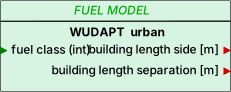
WUDAPT 10 fuel model
Description
The World Urban Database and Access Portal Tools (WUDAPT) [1-3] is an international initiative aimed at collecting and providing consistent data on urban morphology and function across global cities. Utilizing the Local Climate Zone (LCZ) classification system, WUDAPT categorizes urban areas based on characteristics such as building height, density, and land cover. This standardized framework facilitates the analysis of urban environments in relation to climate, weather, and environmental studies.
While WUDAPT primarily focuses on urban climate studies, the detailed information it offers on building properties—such as dimensions, materials, and spatial distribution—can be valuable for assessing urban fires.
Firebench dataset content
Variable name in dataset |
Unit |
Standard Variable Name |
type |
Source |
|---|---|---|---|---|
side_length |
m |
building_length_side |
float64 |
[1,3] |
separation |
m |
building_length_separation |
float64 |
[1,3] |
Usage
Import the WUDAPT fuel model data using FireBench with:
import firebench.tools as ft
fuel_data = ft.import_wudapt_fuel_model()
The data is stored in the dictionnary fuel_data. The keys are the standard variable names and the values are numpy array associated with pint unit.
Compatibility with fire models
Compatibility levels:
Full: The data contained in the fuel model covers all the fuel input needed by the fire model
Partial: The data contained in the fuel model covers some of the fuel input needed by the fire model
None: The data contained in the fuel model covers none of the fuel input needed by the fire model
Fire model |
Category |
Compatibility level |
|---|---|---|
Rothermel_SFIRE |
ROS vegetation |
None |
Balbi_2022_fixed_SFIRE |
ROS vegetation |
None |
Hamada_1 |
ROS urban |
Full |
Hamada_2 |
ROS urban |
Full |